Wassaw Island Fort: The History of Battery Morgan
The Sunken History of Wassaw Island: The Legacy of Lt. Henry Sims Morgan
Battery Henry Sims Morgan, better known as the Wassaw Island Fort or simply Battery Morgan, is a Spanish-American War-era coastal gun battery built in 1898 on the north end of Wassaw Island, in the Wassaw Sound, near Savannah, Georgia. Designed and built by a 21-year-old West Point graduate, it never fired a shot in battle, and today its concrete ruins sit more than 50 yards offshore, slowly being reclaimed by the tide.
The coastal defenses of Georgia hold stories of brilliance and bravery — none more poignant than that of 2nd Lieutenant Henry Sims Morgan. Though his life was short, his engineering legacy still sits, now partially submerged, on the north end of Wassaw Island.
Wassaw Island Fort (Battery Morgan), at a Glance

- Official name: Battery Henry Sims Morgan, named by the Georgia Department of Natural Resources in 2006
- Built in 1898 by 2nd Lt. Henry Sims Morgan, part of the Georgia coastal defense system alongside Fort Screven
- Located on the north end of Wassaw Island, near Savannah, Georgia
- The largest single fortification built in Georgia specifically for the Spanish-American War
- Never fired its guns
- Now sits 50+ yards offshore due to natural erosion following Hurricanes Matthew and Irma (2016)
- Only visible by boat, and best seen at low tide
Henry Sims Morgan was the first person from Valdosta, Georgia, to become a West Point graduate. Following graduation in 1897, Morgan was assigned to the Army Corps of Engineers at Fort Screven on Tybee Island, where he designed and supervised the construction of the Wassaw Island Fort on the north end of Wassaw Island, with permission from the Parsons family, who owned the entire island at the time.
Together with Fort Screven, the gun battery on Wassaw Island formed part of the Georgia coastal defense system built for the Spanish-American War (1898).
It’s said that Lieutenant Morgan was a brilliant individual who oversaw the construction without any plans other than the ideas in his head — a standard rectangular military design measuring 86 feet long by 39 feet wide. At the center, a massive ammunition magazine had walls up to six feet thick. The structure included two cylindrical gun platforms, each with its own observation station and stairway down to the magazine, plus a second set of steps leading to the ground.
After completing the battery, Lt. Morgan returned to Fort Screven and was promoted to 2nd Lieutenant. He died a hero on August 31, 1898, while attempting to rescue sailors stranded on a grounded ship during a storm.
The Wassaw Island Fort never had to fire its guns.
In 1923, his classmates erected a memorial for Lt. Henry Sims Morgan on the grounds of Fort Screven. While locals knew the battery as Fort Morgan for decades, the Georgia Department of Natural Resources officially named it Battery Henry Sims Morgan in 2006.
Seeing Battery Morgan Today
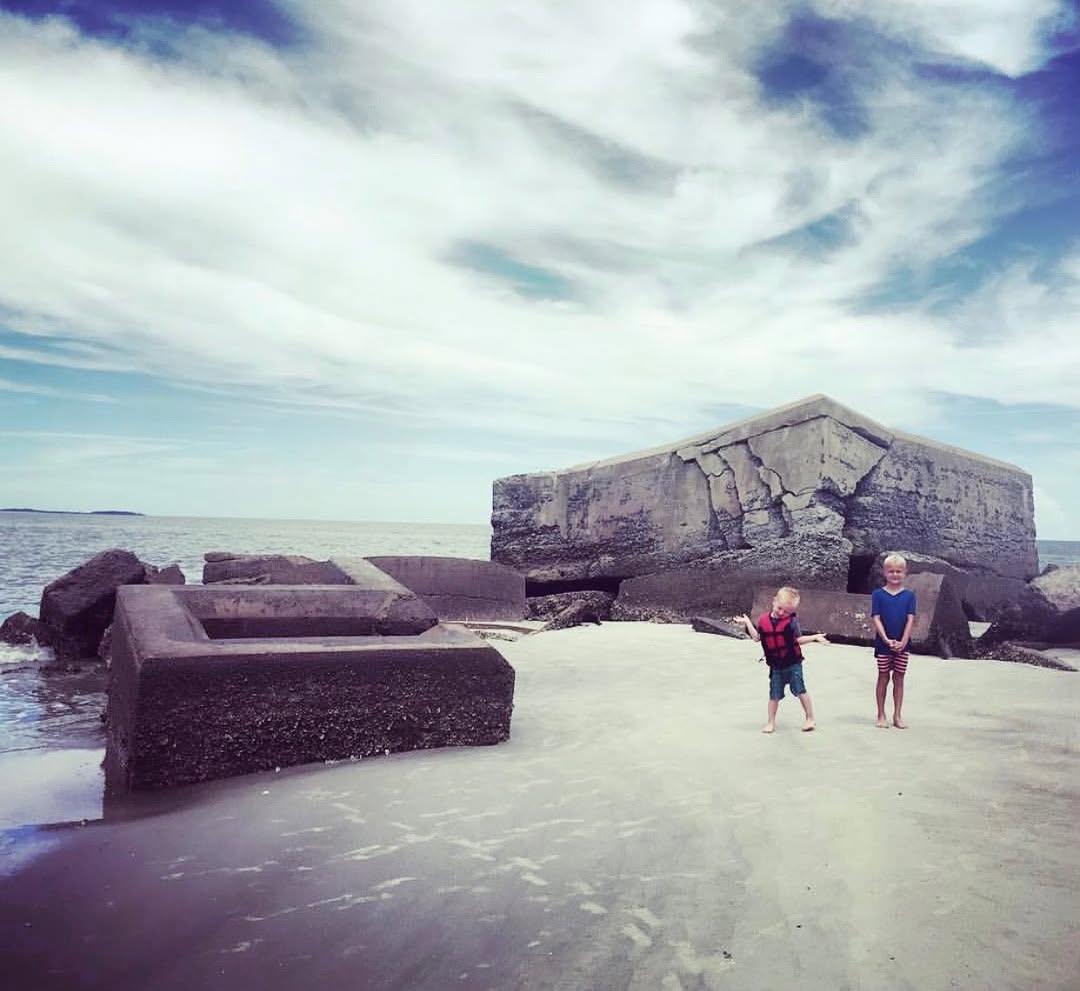
Captain Bryan's sons in front of the Battery Morgan ruins on Aug. 15, 2016 before it started to disappear into the ocean less than two months later by Hurricane Matthew.
Once a sentinel on the dunes, Battery Morgan is now a casualty of dramatic, yet natural, coastal erosion. Following the 2016 hurricane season (Hurricanes Matthew and Irma), the shoreline shifted so significantly that the battery now sits 50+ yards offshore.
- Low Tide Viewing: The best time to see the ruins is during extreme low tide, when more of the structure is visible above the waterline.
- Safety Warning: Do not attempt to swim out to or climb on the ruins. The tidal currents around the structure are extremely strong, and the concrete is unstable.
Wassaw Island, part of the Wassaw National Wildlife Refuge, has no bridge and no public ferry, so Battery Morgan is only reachable by water. A private boat tour is the easiest way to see the ruins up close (safely, from the water) along with the rest of Wassaw’s undeveloped beaches and wildlife.